Not to be confused with Castlevania. Completely different games.
Koji Igarashi, the madman, did it. He successfully led a multi-million dollar Kickstarted to deliver exactly what the fans wanted. Bloodstained - Ritual of the Night is the Castlevania successor we wanted, nay, needed. While the game does little in treading new ground, this is a homage and tribute to all the Metroidvanias Iga had developed during his tenure at Konami, as a matter of fact, the game takes so many cues from Symphony of the Night it might as well be a spiritual reboot. And yes, I'm coining that expression.
The game's plot is pretty silly, and I found the introductory cutscene to be needlessly long, but it gets the job done: You are Miriam, our new resident badass, suffering from an affliction that's turning her body into stained glass. As if that wasn't bad enough, her friend Gebel has gone off the deep end, so she sets out to stop him and his evil ways. Simple, dumb, just the way a Metroidvania should play out! On another note, this might pretty well be Iga's largest castle yet, and it even features a few challenging bonus bosses. Order of Ecclesia-challenging bosses. As far as the difficulty goes, it's not as easy as Symphony of the Night, but it's not as challenging(barring the bonus bosses) as Order of Ecclesia, sitting at a happy medium.
Bloodstained features the usual Metroidvania tropes of exploring a large environment, a Castle in this case, with progression being held back by obstacles that require finding specific power ups to clear. Along the way Miriam will be battling a ton of baddies, earning experience to level up and increase her stats, as well as scavenging for equipment. There are a ton of different weapons, and there's even a simple crafting system to create even more weapons and pieces equipment. Heck, a few accessories will actually show on Miriam... for good or bad. I wish that could've been toggled on and off, since some of the silliest looking equipment pieces also had good stat increased. Speaking of looks, if you find a specific NPC you can alter Miriam's hairdo, hair color and even the color of her outfit. Simple, but fun, hope future Igavanias only expand on the character customization features.
Crafting elements isn't the only thing Bloodstained borrowed from Dawn of Sorrow, as the game features Shards, with are analogues to Souls from the Sorrow duo. Defeating enemies not only has the chance to reward you with loot, but there's also the chance that it might drop its Shard. Shards come in various color-coded types, Miriam being able to equip one of each at the same time. Red shards are used with the X button, Blue shards and purple shards are used with the R buttons, yellow Shards give you passive bonuses(And once fully upgraded turn into White Shards, shards that are active at all times) and, lastly, Green Shards summon familiars, like Symphony of the Night. There are over a 100 different Shards, and each Shard can be strengthened by collecting the same Shard and they can also be upgraded by going to the crafting NPC. More shards of the same power will usually increase its strength, while the crafted upgrades tend to extend their range or the such. The shard system is, like the soul system before it, brilliant. Drop rates tend to be more generous than other Castlevanias, which makes sense considering how much stuff you can craft.
It's easy to tell that Iga wanted his new game to be a celebration of everything he's done before with the Castlevania franchise, as such you'll be noticing a lot of winks and references to his previous Metroivania games. It might stick too close to Symphony's blueprint: The game ending prematurely if you defeat the boss without having the special means to stop him, said special means requiring you to get an armor that can withstand spike damage, having a librarian... for all intents and purposes, it's a very classy stealth Symphony of the Night spiritual reboot. And you can tell that a lot of love was spent making this game.
...however, while it's easy to tell that this was a passion project, it's also easy to tell that it was made by a team that wasn't very experienced with the Unreal Engine 4. In this sense, the game can be incredibly unstable. Look, the game was poorly optimized on the big consoles(PS4/XOne) featuring undeserved framerate drop, so a Switch Port of something that didn't run as well as it should is, unsurprisingly, even worse. Yes, the game can struggle to maintain 30 fps, so much so that you'll eventually start getting 1-2 second freezes every now and then. I thought my game froze(Like, a freeze freeze) after I defeated the second-to-last boss since the game froze for about 6 seconds. I was about to reboot the darn thing before it unfroze. That said, unlike what alarmists would have you believe, the game is far, far from unplayable. Suboptimal? Yes, but the game is perfectly playable, and so much fun that it's hard to care too much about it.
Sadly, the instability doesn't end there. Every single port of the game is prone to crashes, albeit in a predictable way: Interacting with bookshelves and NPCs has a chance to crash your game. Eventually you'll learn that it's best to wait interacting with an NPC until you saved your game, and while it's worst in the Switch version, every port has this issue. There were a few other technical issues, like a few specific rooms having long load times for whatever reason. There's one in the library that comes after a jump, so if you didn't held jump long enough, Miriam may just drop below the platform triggering the loading screen again. During the latter parts of the game, my enemy compendium sometimes displayed at 0.00% even though it was almost full. There also seems to be an issue with how rooms are connected, since about 3-4 times, while entering-and-exit a room in order to try to get an enemy shard or drop, I would teleport to another zone that was close by. This got me to break a sequence once and get through a door triggered by a switch that was on the opposite end of the room! Another two times I couldn't get out of this void, so I had to use a WayStone to teleport back to town and not lose any progress.
It's easy to see that the team struggled with the game, there's a reason it got delayed so many times and and how there are framerate issues even on the upgraded current-gen consoles, but because of that the entire game isn't on the cart/disc at the moment. The mandatory alternate characters? The bonus modes, including multiplayer? All of them are to come in the future as free updates. That said, as much as I hate having to settle with a physical/digital hybrid for the entire game, I can say that what we got is a complete game, what's coming is just the cherry on top.
When it comes down to it, Bloodstained Ritual of the Night is pretty darn great, and it's sure to scratch that itch Konami refuses to acknowledge. A lot of love and care went into designing this game, and I'm sure that Igarashi and his team will be able to polish the game through patches as they get more comfortable with the engine. It's also worth mentioning that the Switch version is definitely the worst way to experience Bloodstained, but even so it's still a great game.
8.5 out of 10
A blog of Swords and Joysticks. And maybe comics, I like comics. Movies too, we can have movies right?
Saturday, July 20, 2019
Monday, July 15, 2019
Review #671: 64 Memories - Hybrid Heaven
Featuring a RPG/Fighting game hybrid!
Part I: The Flashback
Yes, yet another Nintendo 64 game I had always wanted to own but never got the chance to, we couldn't even find it up for rental! The game's art looked fantastic, with the Ryu and Ken lookalikes and the whole RPG/Fighter hybrid mechanics. Everything I could scrape and read about the game made me sure that this was a game I wanted to own. And considering how RPGs and Fighters were my favorite genres back then, with games like Legaia and Xenogears being among my top favorites thanks to their hybrid nature, I would've loved this game.
Part II: The Review
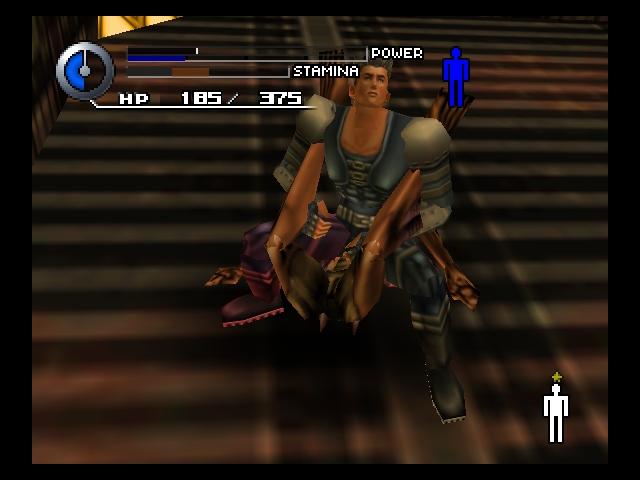
Hybrid Heaven is fun but with a few caveats. What most sources fail to mention it's that it's also a bit of a third-person shooter, featuring simple, if boring, level design as well as basic robot-enemies that you can defeat with your energy gun. As a matter of fact, there's a boss fought entirely through the third-person shooting mechanic... and it's also one of the most annoying ones, since Johnny, the main character, gets rooted to the spot he was standing on the moment you try to aim his gun. It's very clunky and stiff. It's not too bad for most of the game since the basic robot enemies are pretty dumb, easy targets, but this one boss....
Thankfully, shooting and jumping is but a tertiary part of the game, the main brunt of the game comes in the form of one on one fights against hybrid and aliens. When you and a humanoid enemy get close to one another a fight ensues, during which you, and the enemy, can move around the environment. As you both wait for your power gauges to fill, the enemies' are invisible so the AI might as well cheat, so that you can perform different attacks. Once at least one fourth of the gauge is filled you can then press the A button to enter a menu and select an attack. There are about 70 different attacks in the game, in the form of multiple punches and kicks. Honestly, you'll want to focus on a few of those in order to level them up and maximize your damage potential. Each limb also levels up on their own, so you can opt for a jack of all trades that can punch as hard as he kicks, or focus on either set of limbs for a strong fighter focused on a specific style.
But it also might happen that just before you press the A button the enemy will trigger their attack before you, in which case you'll be granted a few defensive maneuvers: Guard, Counter or evade. If you were in the middle of a sidestep when the enemy triggered their attack you just might evade the attack completely. There are other angles to fighting, such as either you or the enemy can try to target a specific body part of the opponent in order to temporarily disable their attacks or handicap them, like slowing them down(broken legs) or getting them dizzy for a while(If you damage their heads). It sounds pretty in-depth, but after you unlock the ability to use combos, all you'll be doing is dancing around the stage waiting for all five gauges to fill so that you can unleash a powerful combo on your enemy. Might as well look for a guide, since a few specific combos have a hidden, extra sixth attack at the end.
While in theory the combat is pretty dynamic, the truth of the matter is that most of the fighting was, as I said above, just moving around, guarding and evading waiting for my five gauges to fill so that I could use the same exact combo every single time. While different enemies should be approached in different ways, such as you'll want to step around a few enemies while close by so that they don't use their projectile attacks, or others will chase you around if you try to run, the end goal of each fight was pretty much the same. That said, I can't deny that I still had fun with the combat system, and I think that I would've liked it quite a bit back in the day. I also enjoyed how pretty much every fight in the first 5 hours or so of the game meant a stat-up of some sort, made depleting enemy-generators a rewarding, if repetitive, ordeal.
The story shows promise at the start, being very dumb and involving aliens, but some of the ridiculousness get replaced with boring nonsense by the end, it doesn't happen that special agent Johnny Slater is mute for 90% of the game. The game lasts about 16 hours, although keep in mind I grinded for a bit and died a few times. And some deaths can be painful, since save spots can be pretty darn sparse. You can't skip cutscenes, when sucks when retrying a boss, and is particularly annoying during the last part of the game which consists of a six-boss gauntlet. You don't want to die and then have to suffer through every boring cutscene again.
While a bit dull by today's standards, I think Hybrid Heaven is a fun experiment. Most of the fun with the game comes from seeing how weird, yet strangely fun the gameplay is, although it grows quite stale by end. That said, I know that I would've loved this game back in the day.
6.5 out of 10
Part I: The Flashback
Yes, yet another Nintendo 64 game I had always wanted to own but never got the chance to, we couldn't even find it up for rental! The game's art looked fantastic, with the Ryu and Ken lookalikes and the whole RPG/Fighter hybrid mechanics. Everything I could scrape and read about the game made me sure that this was a game I wanted to own. And considering how RPGs and Fighters were my favorite genres back then, with games like Legaia and Xenogears being among my top favorites thanks to their hybrid nature, I would've loved this game.
Part II: The Review
Hybrid Heaven is fun but with a few caveats. What most sources fail to mention it's that it's also a bit of a third-person shooter, featuring simple, if boring, level design as well as basic robot-enemies that you can defeat with your energy gun. As a matter of fact, there's a boss fought entirely through the third-person shooting mechanic... and it's also one of the most annoying ones, since Johnny, the main character, gets rooted to the spot he was standing on the moment you try to aim his gun. It's very clunky and stiff. It's not too bad for most of the game since the basic robot enemies are pretty dumb, easy targets, but this one boss....
Thankfully, shooting and jumping is but a tertiary part of the game, the main brunt of the game comes in the form of one on one fights against hybrid and aliens. When you and a humanoid enemy get close to one another a fight ensues, during which you, and the enemy, can move around the environment. As you both wait for your power gauges to fill, the enemies' are invisible so the AI might as well cheat, so that you can perform different attacks. Once at least one fourth of the gauge is filled you can then press the A button to enter a menu and select an attack. There are about 70 different attacks in the game, in the form of multiple punches and kicks. Honestly, you'll want to focus on a few of those in order to level them up and maximize your damage potential. Each limb also levels up on their own, so you can opt for a jack of all trades that can punch as hard as he kicks, or focus on either set of limbs for a strong fighter focused on a specific style.
But it also might happen that just before you press the A button the enemy will trigger their attack before you, in which case you'll be granted a few defensive maneuvers: Guard, Counter or evade. If you were in the middle of a sidestep when the enemy triggered their attack you just might evade the attack completely. There are other angles to fighting, such as either you or the enemy can try to target a specific body part of the opponent in order to temporarily disable their attacks or handicap them, like slowing them down(broken legs) or getting them dizzy for a while(If you damage their heads). It sounds pretty in-depth, but after you unlock the ability to use combos, all you'll be doing is dancing around the stage waiting for all five gauges to fill so that you can unleash a powerful combo on your enemy. Might as well look for a guide, since a few specific combos have a hidden, extra sixth attack at the end.
While in theory the combat is pretty dynamic, the truth of the matter is that most of the fighting was, as I said above, just moving around, guarding and evading waiting for my five gauges to fill so that I could use the same exact combo every single time. While different enemies should be approached in different ways, such as you'll want to step around a few enemies while close by so that they don't use their projectile attacks, or others will chase you around if you try to run, the end goal of each fight was pretty much the same. That said, I can't deny that I still had fun with the combat system, and I think that I would've liked it quite a bit back in the day. I also enjoyed how pretty much every fight in the first 5 hours or so of the game meant a stat-up of some sort, made depleting enemy-generators a rewarding, if repetitive, ordeal.
The story shows promise at the start, being very dumb and involving aliens, but some of the ridiculousness get replaced with boring nonsense by the end, it doesn't happen that special agent Johnny Slater is mute for 90% of the game. The game lasts about 16 hours, although keep in mind I grinded for a bit and died a few times. And some deaths can be painful, since save spots can be pretty darn sparse. You can't skip cutscenes, when sucks when retrying a boss, and is particularly annoying during the last part of the game which consists of a six-boss gauntlet. You don't want to die and then have to suffer through every boring cutscene again.
While a bit dull by today's standards, I think Hybrid Heaven is a fun experiment. Most of the fun with the game comes from seeing how weird, yet strangely fun the gameplay is, although it grows quite stale by end. That said, I know that I would've loved this game back in the day.
6.5 out of 10
Entry #670: Resistance - Burning Skies
Back when games where brown and grey.
Burning Skies is an odd one. Back when the Vita was first announced, one of its main selling points was having AAA experiences on the go, and back then First-person shooters where in vogue and a handheld with two analog sticks was the bees knees, so of course the Vita had to had a few first person shooters! Resistance - Burning Skies was one such game, which arrived to a somewhat lukewarm reception. Well, I'm here to tell ya that it ain't bad at all.
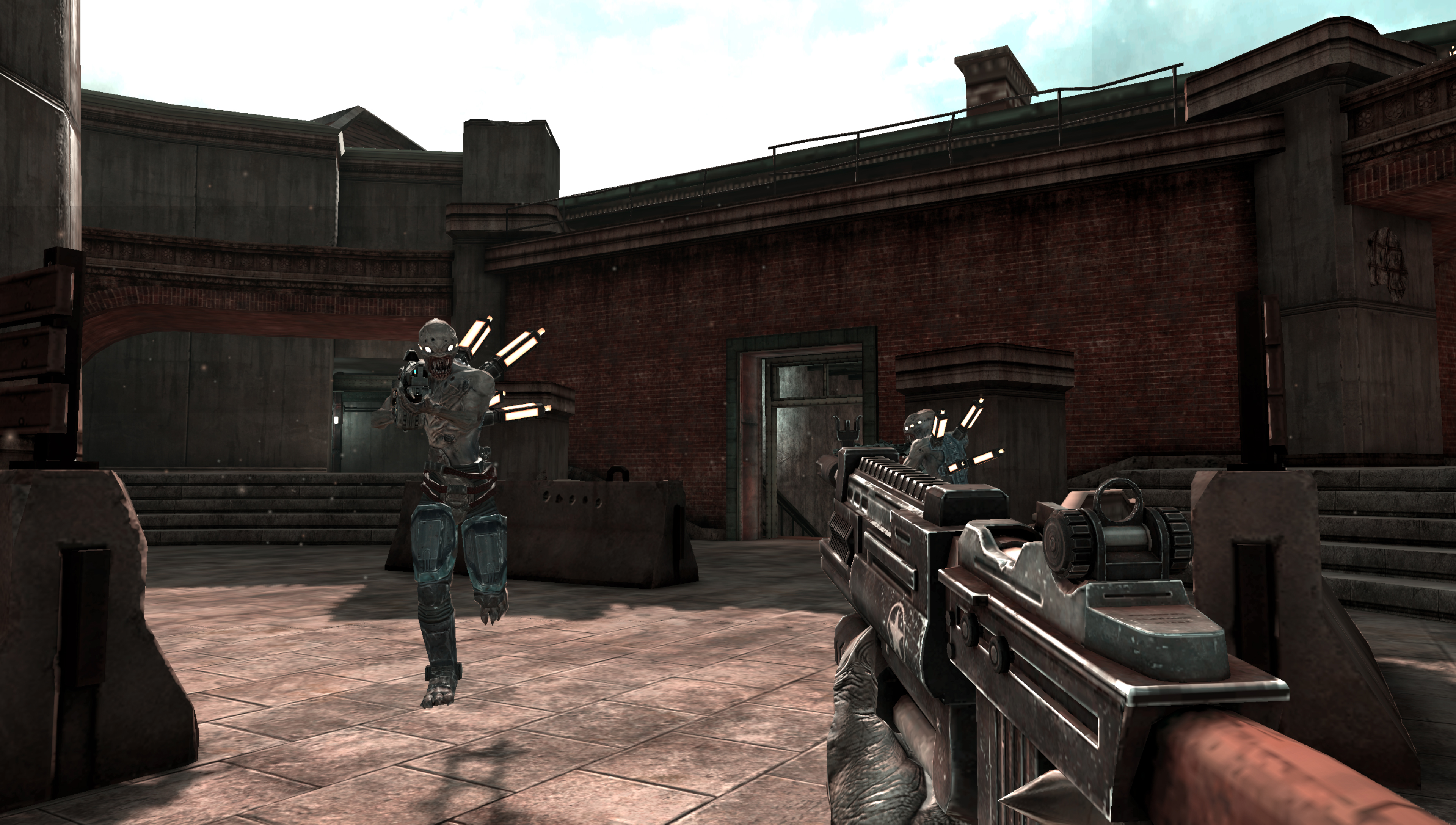
The game has two modes, Online Multiplayer, which of course nobody is playing, and a short 6-level single player campaign. I quite liked my time through the game, each stage is widely different form one another, even if every single stage is either brown, grey or somewhere in-between, making for rather boring environments. The story itself I found passable at best, with a few of Riley's, the main character, interactions with his daughter in the final chapters of the game laughably bad. The game looks relatively good, although there were a few jarry polygons here and there. One level failed to load textures, so I killed myself in order for the game to correct itself. On the other hand, it's surprisingly and satisfyingly gory, watching the enemy chimerae explode into chunky bits felt great. The game is quite manageable, although the final level had a few very tough segments that I could only clear thanks to abusing grenades in order to make enemies panic and give me some breathing room. The last boss while simple to figure out was quite a bastard too.
I really liked the weaponry in this game. I know for a fact that at least one of the weapons came from the home-console games(The wall-penetrating Auger) so I'm not sure how many, if any, weapons are original to this game. Each weapon has a main fire and an alternate fire, and while it's not as unique as Painkiller, weapons tend to have interesting alternate fires. As you go through the game you'll collect alien technology cubes which can then be spent in upgrading your weapons. There's a total of six different upgrades per weapon, but you can only carry two at a time. You can override your pick at any time if you have a spare cube. None of the upgrades, at least the ones I purchased felt too impactful, although having my shotgun blast both rounds on a single shot gave me the added horsepower a berserker Rambo like me needs.
Now onto the controversial, touch-controls. Alternate fire is done by touching the screen. Quick-melee attacks are done by tapping the Axe icon, and grenades are shot by dragging the grenade icon onto the desired point. Also, interacting with objects is done by pressing the touchscreen. That's a lot of different functionalities tied to a single mechanic. Yes, you will occasionally use your alternate fire when trying to open a door or pick-up a wounded soldier, hopefully you won't be carrying the Carbine and kill yourself when you accidentally shot a grenade round instead of opening the door. I never killed myself this way, but I read about a few people that did. Also, as anyone who is unlucky enough to read this knows I love using melee in any game that lets me, so I abused that axe icon like there was no tomorrow and I never had the game register that input incorrectly, so the controls are fine, it's just that the 'open door' icon is a bit too small and it might move as you get closer to a door causing you to press another area and use your gun's alternate fire.
If the game had one huge flaw besides how bland it looks it's how the quick toggle works. Y'see, holding down the triangle button will have the weapon wheel show up on screen so that you can pick your weapon, fair enough. Tapping the triangle button, however, will switch between your whichever two weapons you used last. That's fantastic, and works well enough... except when you die and reload your checkpoint or even after you upgrade a weapon: The game will just forget what was your other quick-toggle weapon, which can be a bit annoying the first few times it happens and your character won't switch out with the other weapon, but once you figure it out you'll prepare yourself after it resets.
I enjoyed my time with Burning Skies. It is pretty basic, and the art-design is pretty uninspired, but the gameplay is fast, tight and, above all, fun. The nice amount of variety when it comes to weaponry was pretty welcome too, I don't remember the last time I felt comfortable just switching between every single weapon in an FPS. And, if anything, the shotgun feels great, and any first-person shooter that gets the shotgun right is A-OK in my book.
6.5 out of 10
Burning Skies is an odd one. Back when the Vita was first announced, one of its main selling points was having AAA experiences on the go, and back then First-person shooters where in vogue and a handheld with two analog sticks was the bees knees, so of course the Vita had to had a few first person shooters! Resistance - Burning Skies was one such game, which arrived to a somewhat lukewarm reception. Well, I'm here to tell ya that it ain't bad at all.
The game has two modes, Online Multiplayer, which of course nobody is playing, and a short 6-level single player campaign. I quite liked my time through the game, each stage is widely different form one another, even if every single stage is either brown, grey or somewhere in-between, making for rather boring environments. The story itself I found passable at best, with a few of Riley's, the main character, interactions with his daughter in the final chapters of the game laughably bad. The game looks relatively good, although there were a few jarry polygons here and there. One level failed to load textures, so I killed myself in order for the game to correct itself. On the other hand, it's surprisingly and satisfyingly gory, watching the enemy chimerae explode into chunky bits felt great. The game is quite manageable, although the final level had a few very tough segments that I could only clear thanks to abusing grenades in order to make enemies panic and give me some breathing room. The last boss while simple to figure out was quite a bastard too.
I really liked the weaponry in this game. I know for a fact that at least one of the weapons came from the home-console games(The wall-penetrating Auger) so I'm not sure how many, if any, weapons are original to this game. Each weapon has a main fire and an alternate fire, and while it's not as unique as Painkiller, weapons tend to have interesting alternate fires. As you go through the game you'll collect alien technology cubes which can then be spent in upgrading your weapons. There's a total of six different upgrades per weapon, but you can only carry two at a time. You can override your pick at any time if you have a spare cube. None of the upgrades, at least the ones I purchased felt too impactful, although having my shotgun blast both rounds on a single shot gave me the added horsepower a berserker Rambo like me needs.
Now onto the controversial, touch-controls. Alternate fire is done by touching the screen. Quick-melee attacks are done by tapping the Axe icon, and grenades are shot by dragging the grenade icon onto the desired point. Also, interacting with objects is done by pressing the touchscreen. That's a lot of different functionalities tied to a single mechanic. Yes, you will occasionally use your alternate fire when trying to open a door or pick-up a wounded soldier, hopefully you won't be carrying the Carbine and kill yourself when you accidentally shot a grenade round instead of opening the door. I never killed myself this way, but I read about a few people that did. Also, as anyone who is unlucky enough to read this knows I love using melee in any game that lets me, so I abused that axe icon like there was no tomorrow and I never had the game register that input incorrectly, so the controls are fine, it's just that the 'open door' icon is a bit too small and it might move as you get closer to a door causing you to press another area and use your gun's alternate fire.
If the game had one huge flaw besides how bland it looks it's how the quick toggle works. Y'see, holding down the triangle button will have the weapon wheel show up on screen so that you can pick your weapon, fair enough. Tapping the triangle button, however, will switch between your whichever two weapons you used last. That's fantastic, and works well enough... except when you die and reload your checkpoint or even after you upgrade a weapon: The game will just forget what was your other quick-toggle weapon, which can be a bit annoying the first few times it happens and your character won't switch out with the other weapon, but once you figure it out you'll prepare yourself after it resets.
I enjoyed my time with Burning Skies. It is pretty basic, and the art-design is pretty uninspired, but the gameplay is fast, tight and, above all, fun. The nice amount of variety when it comes to weaponry was pretty welcome too, I don't remember the last time I felt comfortable just switching between every single weapon in an FPS. And, if anything, the shotgun feels great, and any first-person shooter that gets the shotgun right is A-OK in my book.
6.5 out of 10
Wednesday, July 10, 2019
The DLC Report: Power Rangers - Battle for the Grid Season 1 Jen Scott, Gold Zeo Ranger
Now we've got a proper game!
Well, then, the first two characters from the 3-character season pass are here, alongside a few quality of life tweaks here and there. Besides the individual characters' buffs and nerfs, they added Power Rangers-style sparks whenever a weapon hits a character, which is a pretty neat touch. You also get a blue/red shine whenever a player switches characters when tagging, which is alright by me.
As for the new characters, we've got the Pink Time Force Ranger, she's a rushdown character that's pretty fun to use. Plus, she wields two swords which instantly made me love her. On the other hand, we've got the Gold Zeo Ranger, and he is a blast to play. While I'm not a fan of his staff, they added little flourishes to most of his basic moves and even to his backstep, making him a very fun character to control. His super move is a delayed 'rain from above' type move, like the Green Ranger's, but you can swap him out and the attack will still come out, so it might do for some shenanigans. Overall, both characters are pretty good.
I'm happy to announce that after this patch I can say that this is a proper game. The 14 character roster is acceptable and the gameplay is good fun. It still needs a bit more polishing, like a few extra single-player modes(Survival, anyone?), at least 10 more characters and a few more options, like letting players change the difficulty setting. But the game is on the right track.
7.0 out of 10
Well, then, the first two characters from the 3-character season pass are here, alongside a few quality of life tweaks here and there. Besides the individual characters' buffs and nerfs, they added Power Rangers-style sparks whenever a weapon hits a character, which is a pretty neat touch. You also get a blue/red shine whenever a player switches characters when tagging, which is alright by me.
As for the new characters, we've got the Pink Time Force Ranger, she's a rushdown character that's pretty fun to use. Plus, she wields two swords which instantly made me love her. On the other hand, we've got the Gold Zeo Ranger, and he is a blast to play. While I'm not a fan of his staff, they added little flourishes to most of his basic moves and even to his backstep, making him a very fun character to control. His super move is a delayed 'rain from above' type move, like the Green Ranger's, but you can swap him out and the attack will still come out, so it might do for some shenanigans. Overall, both characters are pretty good.
I'm happy to announce that after this patch I can say that this is a proper game. The 14 character roster is acceptable and the gameplay is good fun. It still needs a bit more polishing, like a few extra single-player modes(Survival, anyone?), at least 10 more characters and a few more options, like letting players change the difficulty setting. But the game is on the right track.
7.0 out of 10
Entry #669: Time Commando
An antique of times past.
Time Commando is one of those games I used to play a lot when I was younger, and I thought it was just as good after I played the first few levels only to discover that it has aged as tastefully as milk as I got further ahead. Time Commando was probably one of the games I played the most growing up. I first heard about it when a friend of mine talked to me about it before eventually getting to play it at his house. A few years later I would end up purchasing the game on PC for myself and having a grand old time. About 10 years since I last played it, here I am, revisiting on PS1, and boy oh, boy was this game best left off in my memories or what?!
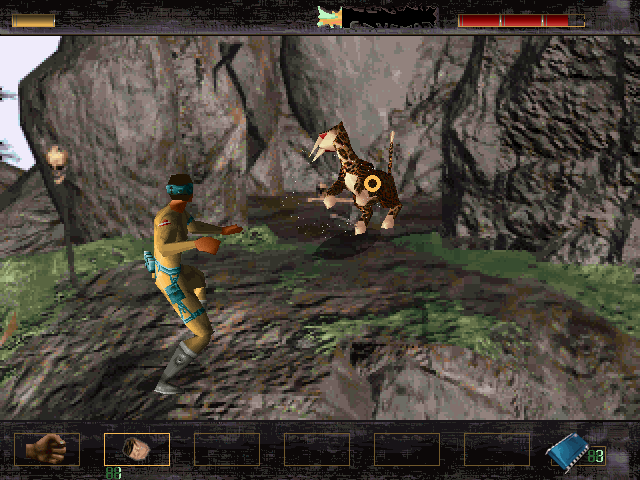
I'll describe the game pretty much like it was described to me back when I was a wee lad: It's an action game in which you go through different time periods beating up enemies, each period having its own set of weapons. I bet that sounds awesome, and I still think that the concept is brilliant. The game has 18 stages, divided through 9 different time periods, and you get 5 different weapons per era. You start during the prehistoric era, fighting cavemen and bears using clubs, stones and a basic spear, then you move on to Ancient Rome, peaking up a dagger, a sword or even a trident, eventually making it to the Conquistadors, when you'll be using a rapier alongside a flintlock pistol. There's a lot of variety, both in enemies, stages and weaponry, making it very hard not to anticipate what'll come next.
Sadly, age hasn't been kind to this game, and it's as clunky as clunky gets. Firstly, while backgrounds look pre-rendered, they are actually a pre-rendered cutscene that 'advances' as you walk forward. It doesn't look as bad as it sounds. Combat is when it gets choppy, you get a backstep and two sidesteps, but attacking is done by holding the attack button and pressing different directions on the D-Pad. Combat is pretty bland, but passable throughout most of the game. Once you hit the middle ages you'll start noticing that enemies start soaking up too much damage. But as soon as you hit the second half of the game, starting with the Wild West, the game takes a nosedive down, down, down as most weapons from then on become guns. Melee combat was sloppy, but projectiles are cheap. It's incredibly easy for enemies to lock you in place once they get a single shot in. You also have to keep in mind that aiming is harder than it should be, particularly at a few choice enemies that use height to their advantage, and you can actually run out of ammo, essentially spelling your doom.
That's not to forget about some of its terrible ideas, like the 'corrupting memory', y'see, the story involves some Virus-thingie, so the time machine's constantly corrupting. You have to collect chips which you can then spend on Terminals to 'fix' the corrupted memory. If the corruption gauge fills completely you'll lose a life. I actually lost a few lives to this stupid mechanic, aided by the fact that sometimes you'll have to interact with very specific background elements, and if you don't interact with it at the right pixel you'll get a big 'Nope' from your character as you aimlessly explore the environment not knowing that you had the right idea, just that poor programming led you astray. And losing a life sucks because it'll also remove a segment from your maximum HP, which you can increase by collecting batteries, very rare pickups. So not only do you lose a life, you also get penalized for it. Fun.
The game has no memory card support, which is interesting to say the least, and you only get a few seconds to write the level password before it fades into oblivion. You'd better pause the game as soon as that bastard pops up, and good luck understanding the password's font. Don't even let me get started on the music, at first I thought I had a faulty disc, but I found a Longplay on youtube that had the same audio issues: The music begins and stops seemingly at random. It's incredibly jarring.
While I had fun revisiting my childhood, at least during the game's first half, there's no denying that Time Command is a pretty bad game. While I think its time travelling ideas, and how they pulled it off, were great, there really is no point revisiting this game unless you have some form of nostalgia for it.
3.0 out of 10
Time Commando is one of those games I used to play a lot when I was younger, and I thought it was just as good after I played the first few levels only to discover that it has aged as tastefully as milk as I got further ahead. Time Commando was probably one of the games I played the most growing up. I first heard about it when a friend of mine talked to me about it before eventually getting to play it at his house. A few years later I would end up purchasing the game on PC for myself and having a grand old time. About 10 years since I last played it, here I am, revisiting on PS1, and boy oh, boy was this game best left off in my memories or what?!
I'll describe the game pretty much like it was described to me back when I was a wee lad: It's an action game in which you go through different time periods beating up enemies, each period having its own set of weapons. I bet that sounds awesome, and I still think that the concept is brilliant. The game has 18 stages, divided through 9 different time periods, and you get 5 different weapons per era. You start during the prehistoric era, fighting cavemen and bears using clubs, stones and a basic spear, then you move on to Ancient Rome, peaking up a dagger, a sword or even a trident, eventually making it to the Conquistadors, when you'll be using a rapier alongside a flintlock pistol. There's a lot of variety, both in enemies, stages and weaponry, making it very hard not to anticipate what'll come next.
Sadly, age hasn't been kind to this game, and it's as clunky as clunky gets. Firstly, while backgrounds look pre-rendered, they are actually a pre-rendered cutscene that 'advances' as you walk forward. It doesn't look as bad as it sounds. Combat is when it gets choppy, you get a backstep and two sidesteps, but attacking is done by holding the attack button and pressing different directions on the D-Pad. Combat is pretty bland, but passable throughout most of the game. Once you hit the middle ages you'll start noticing that enemies start soaking up too much damage. But as soon as you hit the second half of the game, starting with the Wild West, the game takes a nosedive down, down, down as most weapons from then on become guns. Melee combat was sloppy, but projectiles are cheap. It's incredibly easy for enemies to lock you in place once they get a single shot in. You also have to keep in mind that aiming is harder than it should be, particularly at a few choice enemies that use height to their advantage, and you can actually run out of ammo, essentially spelling your doom.
That's not to forget about some of its terrible ideas, like the 'corrupting memory', y'see, the story involves some Virus-thingie, so the time machine's constantly corrupting. You have to collect chips which you can then spend on Terminals to 'fix' the corrupted memory. If the corruption gauge fills completely you'll lose a life. I actually lost a few lives to this stupid mechanic, aided by the fact that sometimes you'll have to interact with very specific background elements, and if you don't interact with it at the right pixel you'll get a big 'Nope' from your character as you aimlessly explore the environment not knowing that you had the right idea, just that poor programming led you astray. And losing a life sucks because it'll also remove a segment from your maximum HP, which you can increase by collecting batteries, very rare pickups. So not only do you lose a life, you also get penalized for it. Fun.
The game has no memory card support, which is interesting to say the least, and you only get a few seconds to write the level password before it fades into oblivion. You'd better pause the game as soon as that bastard pops up, and good luck understanding the password's font. Don't even let me get started on the music, at first I thought I had a faulty disc, but I found a Longplay on youtube that had the same audio issues: The music begins and stops seemingly at random. It's incredibly jarring.
While I had fun revisiting my childhood, at least during the game's first half, there's no denying that Time Command is a pretty bad game. While I think its time travelling ideas, and how they pulled it off, were great, there really is no point revisiting this game unless you have some form of nostalgia for it.
3.0 out of 10
Entry #668: El Shaddai - Ascension of the Metatron
Gives a whole new meaning to Divine Intervention.
El Shaddai - Ascension of the Metatron is quite the experience, the biggest praise I can give it is that it almost feels like a Suda 51 game. Almost. This is a 3-D hack-and-slash action game that mixes in platforming as well as 2-D sections alongside some very surreal imagery to create a weird, inviting beast.
The plot is hard to completely grasp, but it has you playing as Enoch, a heavenly scribe turned warrior, as he is sent back to earth to defeat 7 rogue angels. And then a ton of nonsense happens. While the story is quite simpler than anything Suda 51 would ever do, it still feels like a very surreal experience, with a ton of stuff that doesn't make sense or never gets brought up again. That said, most of the story is plaid straight, so no hidden symbolism or what have you, just amusing stuff like Lucifel(Not a mistranslation, since he is still an Angel his name ends on L) talking with a worried god about Enoch. The graphics are cellshaded, but it's the dream-like design of the levels that really makes the game stand-out. It's weird and very unnatural, which fits the theme of the game so much. Every new area is a feast for the eyes.
Sadly, gameplay isn't up to snuff. The rhythm-based combat is innovative enough, but there are only three different weapons in the entire game, and only so many things you can do with them. There's no point to styling on enemies either, since there's nothing to upgrade. The purifying mechanic was also kinda boring, after using a weapon for a while it'll corrupt, making it much weaker, so you have to wait for an opening to tap R1 to 'purify' your weapon and restore it. Alternatively, you can just hit an enemy until it gets dizzy and then steal his weapon, purifying it in the process. A lot of the time the best strategy seemed to be to just disarm every enemy and then pulverize them with whatever weapon you ended up with. Honestly, the combat was decent at best and boring at worst.
The platforming was also pretty bland, be it the less than precise 3-D platforming sections or the floaty, slippery 2-D platforming sections. Either way, platforming wasn't much fun in El-Shaddai. Mind you, it's not like platforming is completely horrible, it's just passable, forgettable even.
While El-Shaddai: Ascension of the Metatron is definitely lacking as far as its gameplay goes, the unique audiovisual presentation alongside its Suda 51-like script made me really enjoy my time exploring El-Shaddai. I don't think I'll be replaying this one anytime soon, but I am glad I got to play it at least once.
7.0 out of 10
El Shaddai - Ascension of the Metatron is quite the experience, the biggest praise I can give it is that it almost feels like a Suda 51 game. Almost. This is a 3-D hack-and-slash action game that mixes in platforming as well as 2-D sections alongside some very surreal imagery to create a weird, inviting beast.
The plot is hard to completely grasp, but it has you playing as Enoch, a heavenly scribe turned warrior, as he is sent back to earth to defeat 7 rogue angels. And then a ton of nonsense happens. While the story is quite simpler than anything Suda 51 would ever do, it still feels like a very surreal experience, with a ton of stuff that doesn't make sense or never gets brought up again. That said, most of the story is plaid straight, so no hidden symbolism or what have you, just amusing stuff like Lucifel(Not a mistranslation, since he is still an Angel his name ends on L) talking with a worried god about Enoch. The graphics are cellshaded, but it's the dream-like design of the levels that really makes the game stand-out. It's weird and very unnatural, which fits the theme of the game so much. Every new area is a feast for the eyes.
Sadly, gameplay isn't up to snuff. The rhythm-based combat is innovative enough, but there are only three different weapons in the entire game, and only so many things you can do with them. There's no point to styling on enemies either, since there's nothing to upgrade. The purifying mechanic was also kinda boring, after using a weapon for a while it'll corrupt, making it much weaker, so you have to wait for an opening to tap R1 to 'purify' your weapon and restore it. Alternatively, you can just hit an enemy until it gets dizzy and then steal his weapon, purifying it in the process. A lot of the time the best strategy seemed to be to just disarm every enemy and then pulverize them with whatever weapon you ended up with. Honestly, the combat was decent at best and boring at worst.
The platforming was also pretty bland, be it the less than precise 3-D platforming sections or the floaty, slippery 2-D platforming sections. Either way, platforming wasn't much fun in El-Shaddai. Mind you, it's not like platforming is completely horrible, it's just passable, forgettable even.
While El-Shaddai: Ascension of the Metatron is definitely lacking as far as its gameplay goes, the unique audiovisual presentation alongside its Suda 51-like script made me really enjoy my time exploring El-Shaddai. I don't think I'll be replaying this one anytime soon, but I am glad I got to play it at least once.
7.0 out of 10
Thursday, July 4, 2019
Entry #667: Super Dragon Ball Heroes - World Mission
Gotta catch'em all!
Known as that game with the badass commercials depicting what-if forms for a ton of characters, Super Dragon Ball Heroes - World Mission finally made it outside Japan, so we can finally see Super Saiyan 3 Vegeto duking it out against Gold Cooler. It's amazing.
Dragon Ball is no stranger to weird games, so World Mission is nothing out of the ordinary. Based on an Arcade game that featured real cards, this port on the Switch makes everything digital. You don't play as the characters themselves, but rather, you make 7-card decks featuring known and unknown characters from the world of Dragon Ball and fight against another 7-card deck, in a five-turn mini-game extravaganza. It's not a game for everyone and it's definitely not a game for your average Dragon Ball fan, but it's quite fun all things considered.
You won't find yourself out of things to do with this cart, as there is a lot of content packed in this little cart. The story mode is made up of five different chapters, with various sub-chapters contained withing, and most sub-chapters even contain 'alternate dimensions', which translate as another map full of fights. You can also fight in tournaments, 'puzzle fight's and even fight against other players(Sadly no single-console multiplayer), and if you are up to it, you can even challenge Arcade Mode, which is sort-of like Story Mode but without the story and less customization. Add to that that there's about 1000 different cards, and about 350 different characters depicted among those. The amount of combinations and strategies you can build around this massive stack of cards is staggering.
While the game's tutorial is pretty bad, leaves a lot untold or poorly explained and does it in a very weird order. Honestly, you'll learn more about the game by partaking in puzzle fights and by experience alone. The gist of it is like this: Each of your seven cards/characters can fall on any of three classes(Berserker, Hero, Elite) each with different properties, and on each turn you can place your cards on different areas of the playing field, the furthest away from you the more damage they'll deal and the more stamina they'll consumer, while the closest area to you is the 'support' lane, in which characters can restore their stamina or trigger special abilities. Afterwards whoever player goes first gets to attack first, and attacking/defending is all about timing minigames. If the attacker wins the game he'll deal extra damage and, if available, perform a super move. If the defender wins, they'll receive less damage.
Yeah, gameplay is pretty limited here. As a matter of fact, I kinda disliked having to go through timing minigames on every single turn. I mean, I learned to accept it on the long-run, but this is not my kind of game mechanic. That said, the game really shines in the strategy department, as characters come with all kinds of abilities and what not, smart players will be able to craft some really smart moves. For instance, you can even form your deck around a 'Round', like, for example, a deck surrounding Ultra Instinct Goku allowing him to win the game right on the first turn if you win the timing minigame. Since a few abilities can be use AFTER a certain round, you can even build a deck based on surviving the first four rounds and then laying waste to the enemy on the fourth. It's a simple game, and it's actually quite simple to understand after a few matches, but I felt awe at how deep creating a deck can get.
On the other hand, the game desperately needed more animations. Every character shares the same 8-9 basic attack animations, and you'll see them play out over and over and over and over and over and over again. I know, it's crazy to expect them to create different animations for every single character, but they could've gone with different 'sets' of moves shared by different groups of characters, that alone could've gone a long way into making fights look more dynamic. Or at least add more animations, so that you haven't seen every single basic move by the fourth battle you fought.
As for how you actually get your cards, that's done by winning fights and earning Gacha tickets. Those can then be used on the store to randomly get cards. Yes, it can take a while before you can get every character or card that you can, but I was using my most wanted 7 characters by the ten hour mark, so that's not to bad. And while there are rarer cards than other, the game does a good job of making cards useful in some way or another. You could make an entire deck built around Yamcha and still win because some of his cards can increase the speed of the timing minigame for your enemies, tied to the fact that 'weaker' cards have a lower cost for their super moves, so they can start using them earlier. Honestly, no card is entirely useless and there are a ton of ways you can play. You can also build your own card by collecting 'pieces'(The character, the aura, the abilities, etc) through playing the game and then use mix them together in the card-maker. There's a lot you can do in this game, trust me.
If there's one major 'flaw' with the game is how Story fights completely break the game mechanics. Say, you build an entire deck built around depleting the enemy stamina? Too bad, most CPU enemies have unlimited Stamina. By the end, pretty much every enemy has a timing mini-game speed increase on you, and they seem to time their 'perfect's, well, perfectly.
Here's the skinny: Super Dragon Ball Heroes - World Mission is good fun. There's a lot of tools you can play around with to create various different strategies, and there're a lot of different Dragon Ball characters you can toy around with. It's a bit lacking in spectacle, and a few CPU fights are a bit too cheap, but it's a fun game. Fights are so short(Less than 10 minutes each!) that, for a portable game, lends itself quite well to playing in a few bursts. That said, as fun as it was, now I wish Namco would take all these character models and make a new Tenkaichi game on the Switch.
7.0 out of 10
Known as that game with the badass commercials depicting what-if forms for a ton of characters, Super Dragon Ball Heroes - World Mission finally made it outside Japan, so we can finally see Super Saiyan 3 Vegeto duking it out against Gold Cooler. It's amazing.
Dragon Ball is no stranger to weird games, so World Mission is nothing out of the ordinary. Based on an Arcade game that featured real cards, this port on the Switch makes everything digital. You don't play as the characters themselves, but rather, you make 7-card decks featuring known and unknown characters from the world of Dragon Ball and fight against another 7-card deck, in a five-turn mini-game extravaganza. It's not a game for everyone and it's definitely not a game for your average Dragon Ball fan, but it's quite fun all things considered.
You won't find yourself out of things to do with this cart, as there is a lot of content packed in this little cart. The story mode is made up of five different chapters, with various sub-chapters contained withing, and most sub-chapters even contain 'alternate dimensions', which translate as another map full of fights. You can also fight in tournaments, 'puzzle fight's and even fight against other players(Sadly no single-console multiplayer), and if you are up to it, you can even challenge Arcade Mode, which is sort-of like Story Mode but without the story and less customization. Add to that that there's about 1000 different cards, and about 350 different characters depicted among those. The amount of combinations and strategies you can build around this massive stack of cards is staggering.
While the game's tutorial is pretty bad, leaves a lot untold or poorly explained and does it in a very weird order. Honestly, you'll learn more about the game by partaking in puzzle fights and by experience alone. The gist of it is like this: Each of your seven cards/characters can fall on any of three classes(Berserker, Hero, Elite) each with different properties, and on each turn you can place your cards on different areas of the playing field, the furthest away from you the more damage they'll deal and the more stamina they'll consumer, while the closest area to you is the 'support' lane, in which characters can restore their stamina or trigger special abilities. Afterwards whoever player goes first gets to attack first, and attacking/defending is all about timing minigames. If the attacker wins the game he'll deal extra damage and, if available, perform a super move. If the defender wins, they'll receive less damage.
Yeah, gameplay is pretty limited here. As a matter of fact, I kinda disliked having to go through timing minigames on every single turn. I mean, I learned to accept it on the long-run, but this is not my kind of game mechanic. That said, the game really shines in the strategy department, as characters come with all kinds of abilities and what not, smart players will be able to craft some really smart moves. For instance, you can even form your deck around a 'Round', like, for example, a deck surrounding Ultra Instinct Goku allowing him to win the game right on the first turn if you win the timing minigame. Since a few abilities can be use AFTER a certain round, you can even build a deck based on surviving the first four rounds and then laying waste to the enemy on the fourth. It's a simple game, and it's actually quite simple to understand after a few matches, but I felt awe at how deep creating a deck can get.
On the other hand, the game desperately needed more animations. Every character shares the same 8-9 basic attack animations, and you'll see them play out over and over and over and over and over and over again. I know, it's crazy to expect them to create different animations for every single character, but they could've gone with different 'sets' of moves shared by different groups of characters, that alone could've gone a long way into making fights look more dynamic. Or at least add more animations, so that you haven't seen every single basic move by the fourth battle you fought.
As for how you actually get your cards, that's done by winning fights and earning Gacha tickets. Those can then be used on the store to randomly get cards. Yes, it can take a while before you can get every character or card that you can, but I was using my most wanted 7 characters by the ten hour mark, so that's not to bad. And while there are rarer cards than other, the game does a good job of making cards useful in some way or another. You could make an entire deck built around Yamcha and still win because some of his cards can increase the speed of the timing minigame for your enemies, tied to the fact that 'weaker' cards have a lower cost for their super moves, so they can start using them earlier. Honestly, no card is entirely useless and there are a ton of ways you can play. You can also build your own card by collecting 'pieces'(The character, the aura, the abilities, etc) through playing the game and then use mix them together in the card-maker. There's a lot you can do in this game, trust me.
If there's one major 'flaw' with the game is how Story fights completely break the game mechanics. Say, you build an entire deck built around depleting the enemy stamina? Too bad, most CPU enemies have unlimited Stamina. By the end, pretty much every enemy has a timing mini-game speed increase on you, and they seem to time their 'perfect's, well, perfectly.
Here's the skinny: Super Dragon Ball Heroes - World Mission is good fun. There's a lot of tools you can play around with to create various different strategies, and there're a lot of different Dragon Ball characters you can toy around with. It's a bit lacking in spectacle, and a few CPU fights are a bit too cheap, but it's a fun game. Fights are so short(Less than 10 minutes each!) that, for a portable game, lends itself quite well to playing in a few bursts. That said, as fun as it was, now I wish Namco would take all these character models and make a new Tenkaichi game on the Switch.
7.0 out of 10
Subscribe to:
Posts (Atom)